viernes, 13 de abril de 2012

Mana from the Sky

BOOM. A volcano erupting? That was the first thought that went through my head as I lay in bed, reading. It was probably around midnight. The deep rumble from overhead shook my bed and rattled the pages of my light paperback. I´m Reading ¨Kook¨- it´s a surfing novel-  part adventure story, part just plain informative about the sport, history, and culture of surfing. When I first picked it up I was drawn in by the cover: Bright yellow and orange stylized sunbeams, silhouette of a sexy surfer dude dead center. Did not expect the author of this seemingly light summer read to be a genius craftsman of words. I was pleasantly surprised- Peter Heller is a well respected journalist of the adventure travel sort, and has written for National Geographic AND Outside Magazine (¡!).  Reading a book about surfing, I can mentally delve into the seductive realms of the surfing world, catch rad waves and sweeping barrels in my head, and imagine myself with a brightly toned surfboard under my arm, so in the scene, striding confidently across sea swept sands into the rolling ocean.

Of course, this is pure fantasy. My Big Project- to learn to surf while in Nicaragua- has failed miserably. With only a couple days left in Niclandia, my time is spent. I haven´t had the time nor the money to partake in regular 20 dollar surf lessons; after one of those it was clear that surfing isn´t a sport that you can pick up after a couple times. It´s hard core. Requires dedication. When you surf, you surrender yourself to the capricious beast of the sea- The ocean becomes the master. The conductor of waves like music, waves that can move your body softly like a sweet melody, or thrash you, catapult you, smother you at the ocean´s slightest fancy. Vast, powerful, Godlike she reigns.

Surfing is not like rock climbing, my other Project for the year, one that has actually been working out so far. Climbing was instant ecstasy for me; it´s a sport which can be enjoyed regardless of skill level or experience. If I want to really learn how to surf, I´ll need several months on the beach, just surfing. To learn how to really read the ocean. Sadly, that probably won´t happen this year.

So I was lying there reading, and I heard another rolling roar, followed by another. Maybe it´s not a volcano. If it´s something serious someone will come get me, right? Then all of a sudden, a steady stream of white noise. My fan must have gone wild! Or is someone frying something on the stove? Then a knock on my door.  ¨Emma!¨ It was Raf. ¨It´s raining!¨

No friggin way. I leapt out of bed in just my tanktop and underwear, and stepped outside to face the open courtyard which the bedrooms encircle. Raf wasn´t lying- it was POURING! Great torrents of water, bursting from the stormy sky and turning our courtyard into a lake. Waterfalls gushed from the inlets of the corrugated tin roof. Puddles seeped onto the walkway and threatened to creep into my room.

I was ecstatic! We were ecstatic! The whole family present at the time- Mom (Rebecca), dad (Andrew), me, Raf, Jules and Mike- gathered to witness this unbelievable phenomenon. It hadn´t rained a drop in Leon for the entire three months of my stay. Even stranger- we´re in the utter depths of the dry season right now. The sky should be a desert, devoid of any hint of moisture; the air should be crackling with static. I mean, it just was. But now it was RAINING. Can you say unseasonal?

Raf, Jules and I leapt onto the stone washbasin to be as close to the heavens as possible, and screamed and screamed. We turned our faces to the clouds which tumbled and boiled across the sky, first black and then white as blurred lighting cracked behind their nearly opaque fortress. We were drenched in seconds. It was as if we had been bewitched into a child like state of insanity- We yelled and whooped and ran about the house near nude, pure glee.


The next morning, it was as if it had never happened. I was sure it was a one time gift; maybe a wet goodbye kiss to Jules who left that day. But then that night, it happened again. I was at the payphone chatting with Alia when I heard the sound I now recognize as a thing called thunder. I walked home at 9 under awnings spilling with rainwater, ran across roads turned to rivers, and quickened my pace through the stormy suddenly unfamiliar streets to the safety of home.

We have no idea what´s going on. This really shouldn´t be happening. Theories range from this being a freak incident to this being the rainy season come two months early. I think it´s global warming. Whatever the case, I love it. Everything smells wonderful; wafts of rain soaked concrete remind me of Seattle. I can run under overcast skies and not come home feeling like I´ve been stranded waterless in the desert for a week. The rain is revitalizing- it´s the long awaited deep drink that we´ve been holding out for. It´s filling our parched skin and parched souls like breathing life into a bag of dehydrated camping food.

For Nicaraguans, this unexpected mana from the sky must be a disappointment. It´s Semana Santa- the holiest and most important week of the year here- from April 1 to April 8 (Easter Sunday). This means one of two things for Nicaraguans: Either you´re religious, in which case you stay in the city to participate in daily activities and nightly precessions, or you´re not religious, so you go to the beach. Semana Santa also means no school for the kids, so families really make a vacation of it. Beaches up and down the coast are packed with sunbathers, partiers and picnickers for 8 days straight- it´s the Spring Break scene gone wild. So I assume that the rain will not be a welcome addition to their festivities.

Semana Santa is chock full of holy days- Lazarus Saturday, Palm Sunday, Maundy Thursday (Holy Thursday), Good Friday, and Holy Saturday, Ester Sunday. I guess the Catholics decided everything would be easier if they could just concentrate all the holiness and celebration into a single week- get it all over with in one go. Leon is famous for its Semana Santa processions. Here, the devout create art on the streets to celebrate holy week- detailed depictions of Jesus, the Virgin Mary, and Leon´s cathedrals, out of colored sawdust. At night the parades pass through the ¨carpets¨, as they call them- fleeting reminder of the transience of beauty- and scatter the sawdust. Unless the rain gets there first.  I´m not sure if the precessions will be happening if this continues.

Procession on Easter Sunday.

This has been a strange week in many ways. The rain, Semana Santa… everything is closed, so it´s like Sunday on crack for a week straight- it´s also my last week here, and perhaps strangest of all, I haven´t been hiking.

 Not that that was my choice. Quetzaltrekkers has been booming with business for months, and in the space of a day, we hit low season like running into a brick wall. All of a sudden, hikes stopped going. We´d get one or two clients signed up for Volcano Boarding, zero for El Hoyo. It´s been incredibly strange.

To be honest, I´m not complaining. I have thought about how nice it would be to have a week extra in Leon without working, to finish up last minute business and just plain relax and enjoy the city. Be here without being stressed out. So I got my wish in a way. It´s been really good for me, and I´ve been relaxed and getting enough sleep.  

A sudden halt in hiking does not mean our trivia and raffle events stopped happening though. Trivia nights are hosted by Quetzaltrekkers and occur every other Monday at Via Via restaurant. They´re quiz nights that have little to do with Quetzaltrekkers except to raise awareness of our existence and sneak in some tidbit of information between slides. The raffle is a rarer event- it´s strategically scheduled for the Friday before every full moon, to publicize the Full Moon Hike (an all night hike up Telica).

I am Events Manager, which means I coordinate the preparation and execution of Trivia and Raffle nights. Rebecca creates the actual trivia questions, while I make copies of answer sheets, set up sound equipment, count money, delegate responsibilities (putting up the projector and screen, grading, being in control of the nightly activity, and shouting out the questions in English and Spanish, in case the people can´t read what´s clearly written on the projector’s screen.)

Trivia nights are mostly a blast- they create a fun, chaotic atmosphere, a full house of Leon residents and tourists just stopping by, shouting, drinking, catching up and meeting people. It can get VERY competitive. I love that; I think it´s hilarious. The longer I´ve been in Leon, the more and more people I know or at least recognize coming back to trivia nights every other week. Lately, we´ve been combining trivia and raffle, so the raffle tickets are sold throughout the night and the winner is chosen at the end. Of course, all the proceeds go to the same pot as our hiking income does, to the street kids.

 A few days ago my very last trivia and raffle came and went. When ¨lasts¨ start to crop up more and more, it´s hard to keep ignoring that I´m leaving very soon… 

jueves, 12 de abril de 2012

Running and Climbing Should be FUN

How much you love your community depends on how wide the sidewalks are. Rebecca told me so. Apparently, there was a survey done to pinpoint what element of a city or town makes the residents most content to be there, and the variable with the tightest correlation with people´s happiness was: Wider sidewalks.

It makes sense. With a spacious sweeping sidewalk, one has the option to have a small or large personal bubble. You can cozy up next to whoever you´re taking a stroll with, or you can stay the hell away from everyone around.

Most importantly, there´s no bumping. Nothing is more aggravating than constantly slamming shoulders with your fellow pedestrians, or squeezing through a thick group of slowly ambling Nicaraguans… The very worst is when you´re walking along at a fast clip, just trying to get from Point A to Point B with the maximum efficiency, and- BAM. You hit a Wall of Nicaraguan. With the size of Leon´s sidewalks, this could be as little as one Nicaraguan. Your pace slows to an almost imperceptible crawl, at the most one tenth its former speed. You take a step. Then…. Another. You try to cut around them in the street but cars are zipping past. You surrender to the pace considered normal in Nicaragua and crawl along, silently cursing the backs of the torpidly trudging blockade infront of you, irrational anger building until you reach a corner and they go right. You go left- it´s the wrong direction, but the detour is worth the hassle… Until it all happens again.

Now imagine you´re on a run, and this happens every minute or so. There are no nice, green parks in Leon to run in. There are no trails weaving through fields or forests. There is no seaside footway nearby. There are buildings, people, motorized vehicles and other such moving contraptions that fill the roads, and chaos.

Additional hazards of running include: Falling in manholes; twisting your ankle on roots which rip apart the concrete of the sidewalks where sidewalk exist; smaller holes just big enough to sprain your other ankle; getting run over by a car, motocycle, bicycle, bus, camioneta, horse, or cow; heatstroke or death by dehydration; etc. All of which I have had the misfortune to experience in full or partial force.

Ah, Leon. In moments of frustration, the single most mood soothing thing to do is spend a couple hours at Pan y Paz, Leon´s French bakery. After months of experimentation and thought, I have landed upon Pan y Paz as the best place in Leon to relax. Smooth jazz sings in subtle corners, walls are in whites and subtle shades of lavander, archways surround a central garden open to the sky. The sun paints the dancing foliage and the walls calm orangey shades of sunset in the evening hours. Everything is clean, simple, and elegant. It´s my escape.


It seems to be the escape for many others as well- Pan y Paz is where Europeans come to mingle. Even when in a foreign country, one you´re visiting perhaps to escape your own home and culture, everyone is drawn to a familiar setting. Although I´m not French or European for that matter, I beleive spending a Little time there once in a while is critical for my sanity. I decided that after vacation, I would make a consious effort not to get too stressed out. Of course I can´t 100% control that. As was the case during my first trek from coming back…

It had been a month since I´d done El Hoyo last. At least. The last time I´d guided it I´d taken the wrong path twice. So I was nervous. It was just Lynn and I, which was great, because it meant a low stress environment and a fun companion. What concerned me was the lack of veteran guide back up just in case I got lost…. Oh yeah. I´m the veteran guide now.

At the Ranger Station, the group went volcano boarding and I scouted out the beginning of the trail, to make sure I could actually find it. Getting lost in the first five minutes of a trek would not be the best first impression. I did find it, but everything looked very, very different. In the last month, the weeks straddling March and April, dry season went from a gente argument to a full force delcaration of war. Since I had last seen the trailhead, half of the trees had gone, their leaves leached dry by the rattling death suck of Niacaraguan summer. What was once wooded shade was now cracked, exposed dirt.

To my great releif, we made it to the campsite in perfect timing and I didn´t miss a beat. It even took us the exact 1.5 hours I predicted to climb the first hill. Although Lynn and I forgot our tent´s ground cloth and both of our phones died, meaning we had to ask a client to wake us up at 5 (embarrassing), there were no hitches until we started on our way down after breakfast.

Again, everything looked different. Not just drier- everything was burnt. I knew there had been bush fires on Las Pilas because the Park Ranger had told me on the way up. It looked like El Hoyo had suffered an attack too- every other tree was burnt to a black, mangled crisp. The rest were dried to a crisp.

An hour or so in, we came across a roadblock. A towering pile of boulders, completely impassable. The path wasn´t right either- it was a wider hay covered strip that seemed as if someone had passed through with a monstrous mower. I scouted to the right, bushwhacking macheteless (I always figure a machete will do me more harm than good) through yellow grass and branches cracking and spiny with dehydration.

Found it. Ten minutes later, a ginormous tree lay in front of the path. I tried to squeeze through its horizontal trunk and branches... No way. We blazed our own trail to the right. We had had some bumps in the road, big ones actually, but I was still feeling good and confident; I knew I was on the right trail. Until… Oh wait. Maybe not. It wasn´t an epiphany or a sudden realization, but an uncomfortable, creeping sensation that we were not going the right way. The target for El Hoyo Day 2 is Lago de Asososca, to the left of Asososca and between the volcano and Lake Managua. Our trail was veering to the far right of Asososca´s towering figure. And no matter how much I tried to think positively, there was no sudden sharp left. We were heading into the unknown.

Finally, much, much farther than I should have allowed the group to stray, we hit a road. Definitely not normal. I stopped, turned, and gave Lynn that look that says ¨Help! I have absolutely no idea where we are! What should I do! Don´t tell the clients!¨ But they knew. We had a quick chat and I decided there was really only one option: Turn left. So we did. And thank the sweet Lord Jesus the road ran right smack into the fence of the farm we were supposed to find long ago.

I guess we really should have been walking inside the farm. But honestly, I didn´t remember a thing. So I led the group around the outside, hugging the barbed wire, following the ditch that ran along side it and was clearly not a trail.

But we had to find the trail! We had to find the trail to get to the snack spot to get to the way around Asososca… If I kept on walking along this fence I would end up in Lake Managua, lost, phoneless, and responsible for seven human beings. Quietly, secretly, I started to panic. I was almost hyperventilating. Using meditation techniques I had read about but never had the patience to try, I focused on my breath. It kind of worked.

And then, as if God reached down from the brutally blue sky and touched us, the path appeared from inside the farm, winding off to the right. Ten minutes later, we arrived at the snack spot. I almost groveled to the ground, but I was too disgusted by the state of our familiar stop. Once lush and leafy, the tree that always brought shade to our cracker consumption was now a pitiful mass of twigs. I grabbed ahold of the once succulent branch I usually hang on to stretch my back, but realized the pitifully brittle thing would break under any pressure. And there was absolutely no shade. My skin was burning to a crisp. There had been no shade all day.

It´s hard to encourage the clients when you´re about to pass out from heatstroke, but that´s being a volcano guide. The sky screamed at me from above and my skin screamed back. The lake below teased and teased. ¨Asososca. Asosoaka. Soak. Assoossoooaaakkkaaa…¨ Those were the only thoughts my brain could handle.

I have never appreciated a swim more. My body temperature returned to near normal, my seared skin was soothed, my muscles relaxed into a float. We had made it. After lunch, the goings were quick, the way back wasn´t burnt to a crisp and I actually knew which turns to take, and the bus showed up exactly on time to meet us. I was so, so relieved when the last client filed through the front door of Quetzaltrekkers at 4:00. The trip put into perspective what really matters: getting home safely. We were alive, happy, and I wasn´t sick. What I didn´t realize at the tame was that that would be my last trip, probably ever, to El Hoyo. 

martes, 10 de abril de 2012

Climbing Maderas

Up at 7, coffee at 8, and we hit the trail at 9. Since we were set on hiking guideless, Tom and I decided to go with the most secure option and take the trail above Finca Magdalena. At dinner the night before we had run into a troop of Brits fresh off the trail and caked in mud from their goofy Indiana Jones hats to the trips of their hiking boots. They had also down Maderas without a guide, and had (almost) successfully taken the Finca Magdalena route. Their mistake was starting at 11:00 and forgetting headlamps. Finding your way up to El Zopilote in the dark may be a challenge, but finding your way down an unfamiliar volcano through dense jungle sound terrifying, It took them nine hours, which we scoffed at. Our goal was six. Three up, three down.

I was happy to finally get to see Finca Magdalena- that’s where my mom and I were planning on staying when we were going to come to Ometepe. While Finca Magdalena has the same basic operations and ideals as El Zopilote, it’s visually different. Instead of being nestled within the trees, Finca Magdalena rests on a clean, open field decorated with dainty flower gardens. The main building- rooms, restaurant, balcony area- is a classic farmhouse, sun bleached planks and white paint peeling in rustic character. Café tables line the balcony railing, styled like a typical white farmyard fence, where tourists sipped coffees and gazed out across the gardens, Concepcion, and the lake beyond.

Finca Magdalena is an agricultural cooperative made up of 24 members and their families. They are involved in environmental conservation efforts, and lead guided tours up Maderas. The community was hurt by the 1990 elections, during which many of the strides made during the Sandinista era were reversed. Many cooperatives were forced to shut down because they were unable to pay back loans, but Finca Magdalena clung on and survived. The farm wasn’t originally a hostel and restaurant- that element of the business sprang up after hordes of tourists began to pass through on their way up to Maderas´ crater. Since 2000, tourism has been by far Finca Magdalena’s greatest source of income and has morphed the farm into a prosperous haven for its community members and their organic produce.

The trailhead to the crater is obvious and sits right behind the farmhouse. I was relieved to see how official and well kept the trail was. And dry! We had been warned multiple times of the intense mud on Maderas. We had seen evidence covering the bodies of the hikers last night. But it couldn’t be so! It hadn’t been raining- where did the mud come from?

The trail continued to be dry and compact until about an hour up, and I realized how the volcano is able to keep herself constantly moist: The entire upper half of Maderas is wrapped in the permanent embrace of a single, thick, watery cloud. As you hike, the air becomes thicker and wetter until it literally drips with precipitation. You’re being drawn into the clutches of the dense, swirling fog that squats on gentle Maderas like a soggy hat- It’s like you’ve stepped under the little black rain cloud that Winnie the Pooh goes through so much to avoid.

And that’s when the trail gets muddy. Really muddy. At first, I did my best to avoid the ooze by grasping on to the gnarled jungle root that reached out at me like deformed arms, pulling myself onto the steep sides of the trail, leaping over puddles, and balancing precariously on slippery rocks. Around hour two, my hope that my boots would stay reasonable dry shuddered, took one last rattling breath, and died. I sunk in. Up above the high tops of my high tops.

Squelch. Once you resign yourself to hiking through this kind of mud, it can be fun. Possibly my favorite part of the Maderas hike was how different the environment was from my dry hometown hills outside of Leon. Everywhere, gigantic, drooping trees hung with moss and on the moss glistened millions of tiny droplets of dew like sparkling diamonds. The closest thing I had to compare it to was the Olympic rainforest on Washington’s far west peninsula.

As we climbed higher, we hoped that the fog would burn off and that we’d get a view, but all we could see was a dense wall of white. We could have been anywhere. Progress was immeasurable. That was the weirdest part for me: On Cerro Negro, or Telica, the crater of the volcano is in perfect sight for hours. You lock you eyes on the pinnacle of your destination and climb. There are no trees to distract you, no small undulating hills or shroud of cloud, only steaming volcanic rock, the piercing sun, the shriekingly blue sky, you, and the angry crater ahead. In comparison, Maderas was like wandering through a hazy dream or climbing a very muddy stairway to heaven.

Maderas is its own cloud forest. At times, the path was so wet that it was a river. Literally, water streaming down rock towards us. We had to make some executive decisions along the way about which paths to chose, which I felt entitled to make because I was a volcano guide. Of course, my experience had zero effect on an unknown volcano. The way up is simple, though, there is really only one direction in which you need to go. I don’t think it’s necessary to elaborate. The way back down is the tricky part, if you want to come out the same way you came. The real life saver was Tom’s compass, which helped us re-find a couple of tricky spots on the way back down.

We summited and didn’t even notice. Then Tom pointed out that everywhere you looked, the land seemed to sloped downhill. Oh. Look at that. We exchange a summit high five, no need to snap any pictures, and began our descent into the crater. It was about a 20 minute downhill climb, or more appropriately, down hill slip. Still couldn’t see a thing but the mossy tree two feet away. And then all at once, a clear window appeared between the shoulders of trees and we caught a glimpse of a glowing green field and a lake. Excited, we scurried down the last bit of slope, and entered a phantasmal bowl of emerald magic.

 The lake took up most of the crater floor and the rest was strewn with a brilliant lawn that seemed to radiate light. On all sides, the searing green molded into thick jungle that coated the crater walls, and rose jaggedly into the fog. At spots where Maderas´ protective cloud drifted, the spiky crater lip jeered sharp and equally green. The walls were so steep, so sheer, that it was a wonder the dense jungle vegetation clung on. In places the fog visited us, swept down the cliff walls and snaked along the waters. It made dreamlike pools and airborne rivers and infiltrated my mind, putting me in a trance. It was the land of Oz. It was definitely worth the climb and worth the shin high mud that had finally broken through the waterproof layer of my boots.


Finca Magdalena


Tom tested the waters but the ¨lake¨ turned out to be basically a huge mud pool. We feasted on peanut butter and jelly sandwiches, lounging on the lawn and gazing about in awe. But we had a six hour goal, and we’re a competitive pair.

The way down was, honestly, not a whole lot of fun. I’m already not a fan of downhill climbs, but Maderas throws in added bonuses of slick rock, slippery mud pools, and roots that waited in hiding to attack your ankles and bring you down. I fell more than once. The way is also significantly steeper than the volcanoes I’m used to. Towards the end, my knees were shaking, my shins were splinting, and my toes were on fire from being crammed up in the front of my shoes. We reached Finca Magdalena after seven hours of hiking and I collapsed my filthy, energy sapped body, drenched head to toe in slime, onto a nice white seat tat the patio restaurant.

We walked into Balgue for celebratory mango smoothies, and then made our way down the road to El Zopilote just as the sun dropped behind Concepcion. It was our last night on the island; we had to be in Leon the next day for Tom to pack up and catch an early flight the following morning.

For our last breakfast we picked out a little, rustic comedor right on the beach. We sat beneath the palm thatched roof in the early morning, steaming white coffee mugs in our fingers while the white surf crashed and steamed in towards our toes.

It was a good thing we got an early start- it took us ten hours to get from where we had breakfast to the Quetzaltrekkers headquarters. Ometepe is NOT that far away from Leon. But it was a Sunday. Busses crawled. We waited hours for boats and microbuses. When we finally arrived at the soothingly familiar blue front door of the QT HQ after a long walk from the terminal, I reached into my bag and realized I had lost my house key along with my wallet… Oops. No matter, some one would let me in.

I rang the doorbell. Nothing. I rang it again. After ten minutes of this, I remembered, again, that today was Sunday. Sunday means Family Dinner Night, which usually means that every member of our volunteer family would be home eating together, but for the first time in my experience the crew had planned to eat at the beach hostel. Which meant there was not a soul at home. And no way to get in. Tom and I briefly contemplated another round of mock cat burglary, but I had no idea how we would access the roof system that leads into the open courtyard.

We were tired and frustrated and none of our options seemed like good ones. At long last we decided to take a taxi to the beach, retrieve a key, and hop back into the cab back to Leon. Not the cheapest option, but the least stressful. Tom left early the next morning and we both dove back into the working life with not much enthusiasm. My vacation over, I should have been relaxed and refreshed, and I may have been a bit, but we had packed ourselves to the brim with adventure. With three weeks left in Nicaragua, I knew there was more adventure to come.

viernes, 6 de abril de 2012

Bikeventure on La Isla

I woke up in an empty tent. Tom´s sleeping bag lay beside me, but Tom was gone. The tent was so hot. It was already after nine and the sun´s beams seeped through the thin nylon, baking the air inside the tent to a stifling, nearly unbreathable pool of sweaty stagnant air. I think that´s the latest I´ve slept in in a tent in Nicaragua- not a good idea. The next time my alarm goes off at 5 on a trek I´ll have something to be thankful for.

After scouring the kitchen, the showers, reception, and everything in between with no sight of Tom, I decided he must be off on some solo adventure. Not surprising at all, really. Anyway, I recalled saying something along the lines of ¨Maybe I should have a full rest day tomorrow so I can finally recover¨, the night before.

So that I did. I wrote, I drew, but mostly I just chilled out at the yellow bus café- Literally a yellow school bus, or ¨chicken bus¨ as they´re referred to in Central America, permanently parked right off the highway on the trail to Zopilote. When travelers wander through the gate off the road, which looks like it really shouldn’t be opened, confused and standing out like sore thumbs from their baffled expressions, huge backpacks and hippy attire, and it´s still light out, they´ll get a comforting yell from the bus. A head will poke out the back window and inquire if the backpackers look so confused because they´re looking for El Zopilote. If so, the bus can actually phone reception to see if there are rooms.

Since we arrived so late, Tom and I didn´t benefit from this perk of service, so we hadn´t met the bus volunteers yet. Two of them sleep on a bed that takes up the rear of the bus, curtains separating it from the kitchen and shop areas. Man, was I jealous when I saw that. Living in a bus?! How cool is that? It´s a German woman and her Chilean boyfriend; they met in Chilean Patagonia when she worked there as a guide. We bonded over guiding, but then all I wanted to talk about was the intriguing and enchanted land of Patagonia. She could tell I was serious about going there someday- To my delight, she wrote me a list of places and contacts in one of the most intense and beautiful places on earth.

I basically hung out there all day. When Tom came back, it had just started to rain. He walked in from the highway through the sudden downpour, dripping and muddy and smiling huge. He had been on quite the adventure- a mapless and guideless hunt for a secret waterfall, which he may or may not have actually found, but he did find A waterfall, and made some friends along the way. My stomach had been bothering me all day, but it was feeling steadily better. As we hiked back up, I walked at almost normal speed and didn´t have to pause, gasp, and grasp my knotted stomach every thirty seconds. So we decided it was time to leap into action again the next morning.

Ometepe´s villages are sparse and spread out, and public transportation is sporadic if even existent. The road to Balgue (the town nearest to El Zopilote, Finca Magdalena, La Brisa, and the volcano Maderas) was just recently re done, shortening the ride from the port by at least an hour. The best way to fully experience the island and have adventures along the way is to rent bikes. They´re five dollars a day and provide the perfect medium between walking and automobiling.

We wanted to squeeze in as much as we could, since yesterday was lost. The plan was to bike along the water to Ojo de Agua, a swimming hole, and then swing around to Caballitos del Mar for kayaking. Jelmer, my trusty reference for all activities Ometepe, had suggested we rent kayaks from Caballitos and kayak a stream that cuts between the north and South halves of the island, at sunset. Apparently that’s when the birds come out, and Ometepe is home to a plethora of exotic birds- colorful, unreal as if out of a Dr. Seuss book. The Urraca, a big baby blue and white beauty from the magpie family that sports a stately crest on its head and delivers an impressive squawk, is a rare and exciting sight on Quetzaltrekkers hikes. On Ometepe, Urracas abound. Indeed, they´re so bountiful that the locals absolutely hate them. As we biked along the lake we stopped at some farmer´s house to buy tortillas, and I joked that the Urraca should be Nicaragua´s national bird because its colors match the Nicaraguan flag, rather than the bright green Guadabarranco. The farmer was appalled. He went off on a rant about the annoyances of the winged pests.

The beaches we cycled past were strewn with course sands and waves which heaved with the prowess of an ocean. I had to keep on reminding myself that we were many miles from the coast. So far out I could barely see, a horse´s head bobbed in the gray surf. I stopped my bike to take a closer look- there was a man in there with his steed. Nica, long black curly hair and brown shoulders. They were swimming, then prancing through the water. His locks and her mane whipped and sprayed water into the wind, wild and free creatures of the sea.


About an hour later we arrived at Ojo de Agua. I was expecting a hidden natural pool, deserted, maybe a waterfall, buried deep in the greens of the jungle. Wrong. Apparently, every gringo tourist on La Isla is hiding out at Ojo de Agua. It was packed with white, screaming, bikini clad teenagers, families picnicking at the water´s edge, girls sunbathing on the concrete surrounding the pool. Which isn´t exactly a natural swimming hole. It is fed by a spring, but has been built up with concrete retaining walls to emulate a manmade pool.

After the initial shock wore off, I had a great time. There was a rope swing, a bit of a dud, but Tom found a way to make it exciting my attempting flips off of it. He actually managed a full flip, not so easy off of a piece of twine a foot or two over the water. Vendors along the banks sold some of the finest handicrafts I´ve seen in Nicaragua- if you´re looking for authentic, well-crafted jewelry, Leon is, unfortunately, not the place to go. Such things abound in Granada but I didn’t really get the chance to explore Leon´s conservative sister. Ometepe, however, seems not to lack skilled craftsmen. I bought all- literally all- of my souvenirs right there at Ojo de Agua, in one go. That felt good.

We didn´t know exactly how long it would take to bike to Caballitos del Mar for kayaking, so at one point we decided it was probably time to scoot along and got back on the road. We cycled to the critical intersection of the Southern half of Ometepe, a three way with options of Balgue, Merida, or Everything Else (the direction in which we came). Our road of choice was the one toward Merida. I full and foolishly assumed that the road would be bikeable. When we arrived at the cross section, I gulped: This road was so disfigured, so torn apart, it didn´t look driveable, let alone bikeable. Rocks and boulders littered the entire expanse. Ditches and potholes tore open the surface like someone had dropped a series of small land mines. It looked like the dry bed of a fast moving river, one that had syphoned all sediment to expose the unruly rock below. It looked like it had been carved out of the mountainside yesterday.

I looked over at Tom. He looked at me. We looked back at the road. A Nica guy, late teens, cycled towards us, keeping to the far side where there was a narrow shoulder with a bit more dirt to keep the boulders together. He swerved his handlebars and utilized his breaks with the grace of experience, basically guiding the bike´s thin wheels along the larger and flatter rocks and avoiding all pits. So it wasn´t impossible – SOMEONE was biking it. And hey! This could be my chance to finally experiment with hardcore mountain biking! I looked down at our bikes, which we had rented from a family near Zopilote, an informal business with a crusty wooden sign that boasted ¨BIKES¨. These were not mountain bikes. Not at all. They were the kind of bike you ´de buy at Target for cheap, for riding short distances on flat sidewalks until it breaks. My stomach was full of butterflies, but Tom wasn´t saying anything, so we started biking.

Biking that road was probably one of the most terrifying things I´ve done. Scarier than rock climbing. Scarier than jumping off 40 foot cliffs into water. With that stuff, you know you can´t get hurt. The rope will catch you; the water will catch you. As  jerked my handlebars to and fro and kept my eyes, wide with terror, glued on the rubble ahead of me, I was well aware that what was going to catch my fall was the hard, sharp, painful ground. That´s scary.

I lasted about half an hour before I wiped out. It was a good one, too. My wheel hit a dip and I flew over the handlebars and crashed, spread-eagled with limbs littering the debris below. Best of all, I fell right next to a crowd of playing kids. They ran over and, instead of helping me, or at the very least asking if I was alright, they immediately started laughing and pointing. Stupid gringa! She doesn´t know how to bike! Go back to your clean cut streets, your slick pavement, your flat asphalt smooth as a silk sheet. Here, we know how to rough it, we play the real deal.

That hurt my feelings. My body, on the other hand, only hurt for about thirty seconds, during which time I lay there unmoving like a dead man, in pain. Then it passed, and I stood up and checked myself: Bloody knee, bloody hip, bloody elbow, but all bearable. I got back on the bike and we carried on, this time with a train of little punks skipping behind us and pealing with laughter. I was biking more carefully, but I also wanted the hellish ride to be over as soon as possible; I knew that it was only a matter of time before I would crash again. On the other hand, Tom was having a blast. Huge grin on his face, adrenaline rushing through his veins. Jeez. Maybe if my bike had just a little bit of shock support.

About 20 minutes later, we still had no idea how far it was until Caballitos, but a sign appeared out of thin air stating Peru- Kayak rentals. Next right, 500 meters.¨ Peru…? Well, a kayak´s a kayak. We turned right, just as the sun began to set. And then we were at the water´s edge, and amidst a cornucopia of water related sports equipment. Motorboats, rowboats, kayaks, wind surfing kites, surfboards, sailboats! It was obviously some guy´s house who had recognized the advantage of his lakeside property and started collecting aquatic toys to rent out to tourists We told him about our mission to kayak to the river in time for sunset, see the birds, and paddle back in the dark. He shrugged, set us up with a two person yak, and we paddled away.


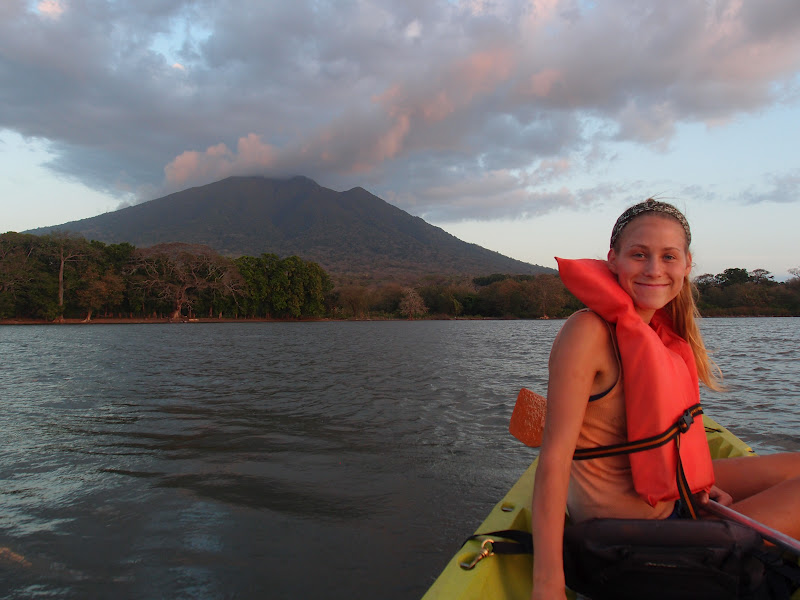
It wasn’t until we were half an hour or so out that we realized that once again, we had no idea how far away we were from our destination. The river couldn’t be that far- had we missed it? The sun was already below the horizon. We paddled and paddled, but it seemed as if progress eluded us, and the river was nowhere to be seen. After rationalizing it out, we decided it would be stupid to try to make it all the way to the river and back in the dark, especially because we had to bike all the way back to Zopilote that night. And we could enjoy floating right here- We were in an idyllic spot, hugging the curved shore of Ometepe’s waist, the inside crescent of her hourglass figure. We were nestled between the two volcanoes, the isthmus, and the open waters of the lake. On our left, Concepcion was a beastly silhouette against the setting sun, yellow and black. On our right, Maderas glowed a soft green, her lush jungle carpets rosy in the dimming light.

When we got back to “Peru” after only an hour, our rental man was disappointed but understanding. We mounted our flimsy, deteriorating bikes- they had gone through a lot- and realized we had no choice but to walk them. There were no streetlights. And although the fact that I literally couldn’t see the horrible shape of the road made it feel more benign, logic told me that wasn’t going to solve anything.  It was going to be a long walk. We whistled, we sang, we contemplated deep things and moral issues, but secretly we hoped and prayed for a truck to come along and pick us up. And then- like out of a dream- a gigantic flatbed rolled unsteadily up and let us climb on board. A team of agile Nica men tossed the bikes into the back with ease and we got another wild back-of-the-truck ride- this one far more exciting than the last. We tumbled through the night air, lurching and pitting into potholes, accelerating down steep stretches to skip over the bigger rocks. I was screaming out loud! I couldn’t believe our luck. What a night! Forget about the scrapes, we were tipping through the dark countryside of the Nicaraguan night in a truck bed full of random furniture, our bikes, and other unknown objects, rollicking along the craziest road I had seen all year!


The driver let us off at the crossroads, and was surprised when we offered him a tip. Biking the rest of the way was comparatively easy (although I had complained the first time passing through) and there was the occasional streetlight, which helped. We dropped off the bikes and in another stroke of luck stumbled upon a restaurant just outside El Zopilote that was still open.

Full from a big Nicaraguan dinner, we realized we hadn’t brought a headlamp. The path up to El Zopilote, already near impossible to navigate in daylight, was a nightmare in the dark. We kept taking wrong turns until Tom had the genius idea to use the glow of his camera screen to light the way. It was just enough to pick out some landmarks, and we finally arrived at our tent.

 I was exhausted, but knew that we had only one full day left. And we still hadn’t climbed a volcano. We hadn’t set up a tour either, but screw that- I’m a volcano guide! We set an alarm for early the next morning; we were going to find our way up Maderas. Nestled in our little tent, sleep stealing us away, we were already perched partway up the mountain. Maderas is dormant, it’s short and shady- how hard could the rest be?